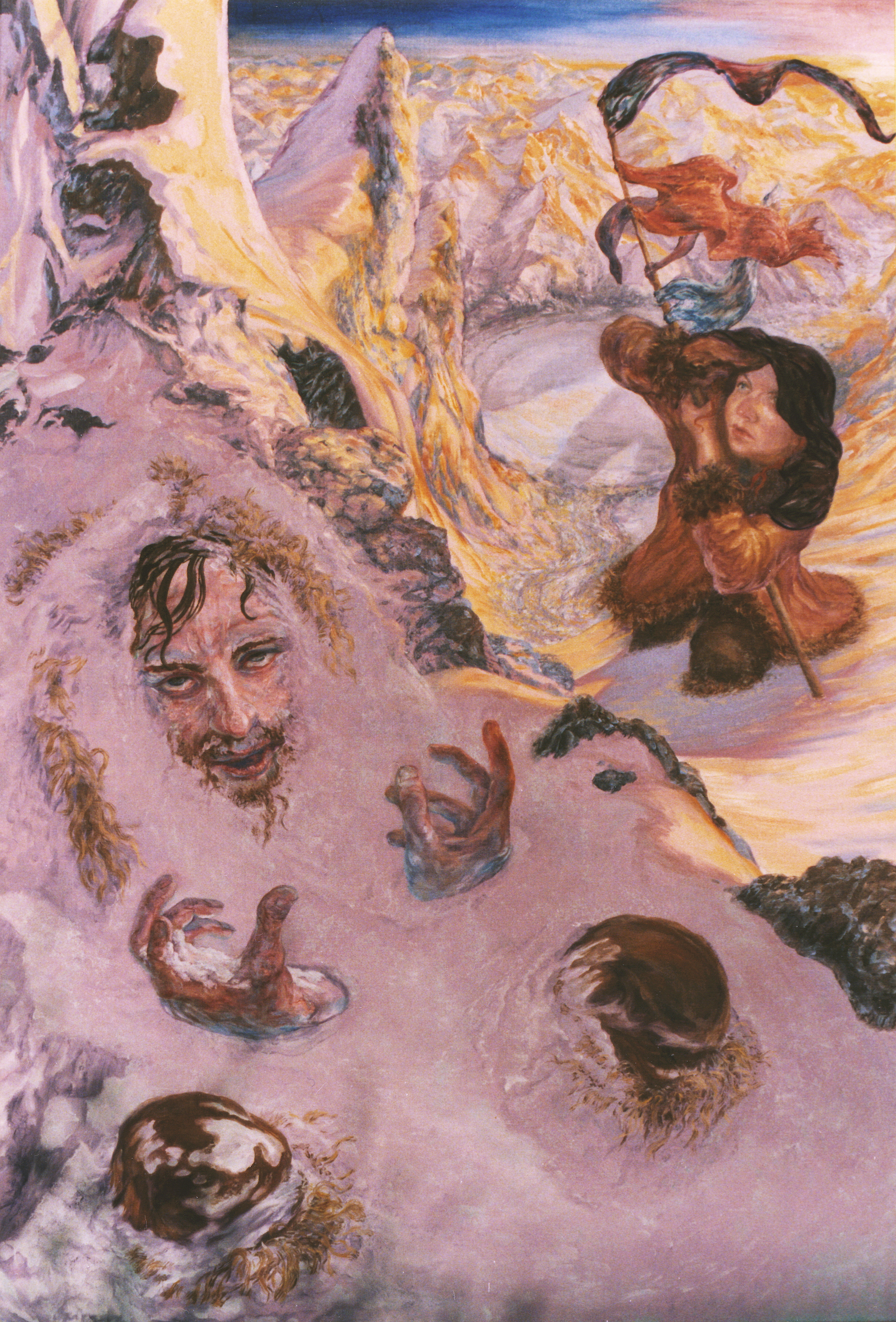
Many climbers have perished attempting to attain the roof of the world “the height, how can I keep out of the height?” were Thomas Mallory’s words in a letter to his wife in 1924. He was last seen near the summit of Everest. The idea of the loneliest death, on such a quest, and the agony of those left behind, inspired this work. The woman, with one aim, seeks out her loved one as her flags etch out the scythe of death against the setting sun.
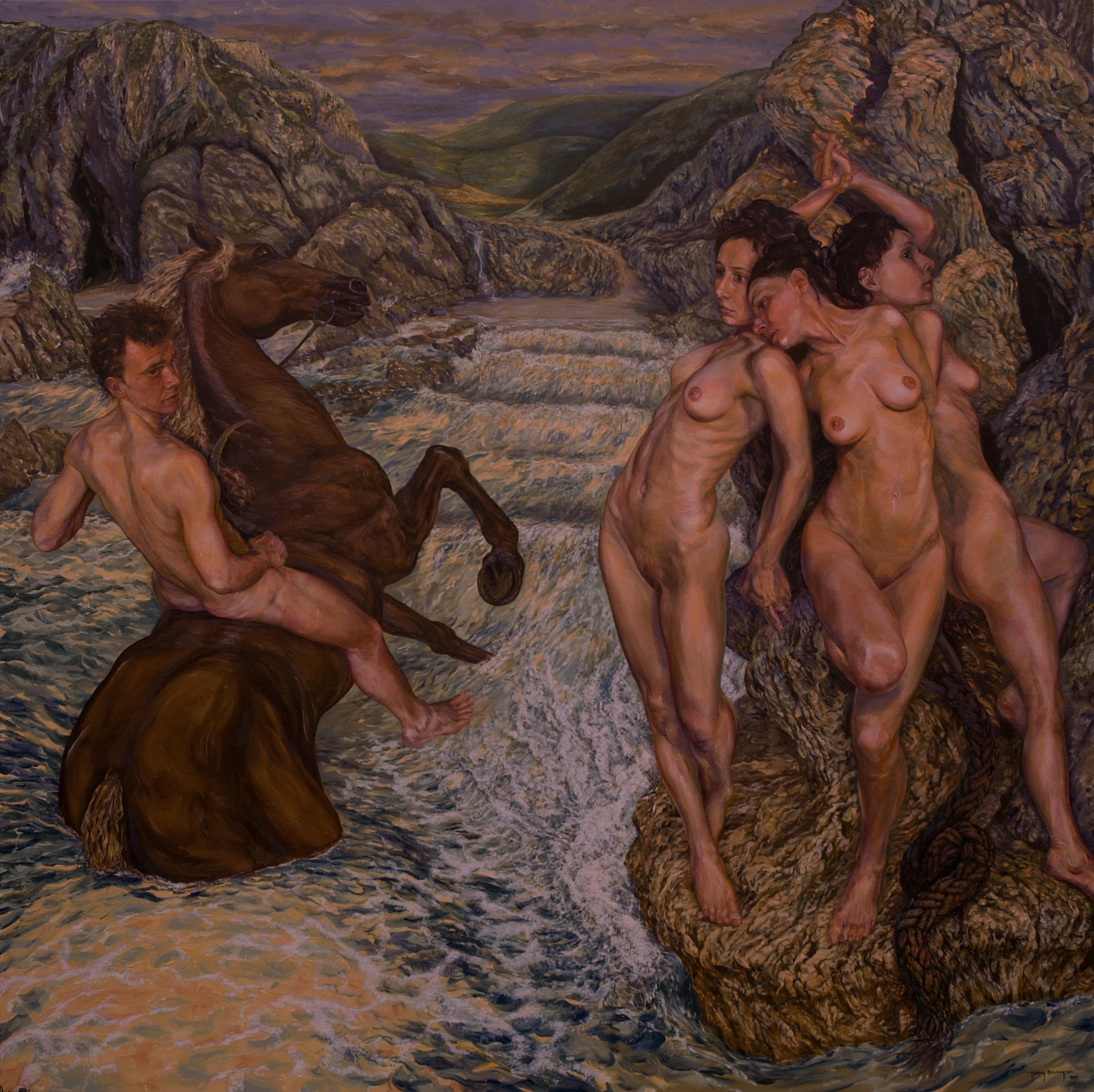
Ovid’s well known story of Perseus’ adventures casts him as the swashbuckling hero who eventually rescues Andromeda, chained victim for the evil Kraken. However the latin ‘Perseus’ means ‘destroyer’ and in this picture he is re-cast as the invader; riding out of the depths on Pegasus, scythe in hand, to rape the land and all its bounty. The ‘hapless heroine’ becomes the triple-goddess; a counterbalance to Ovid’s gorgon, Medusa, and her evil sisters.
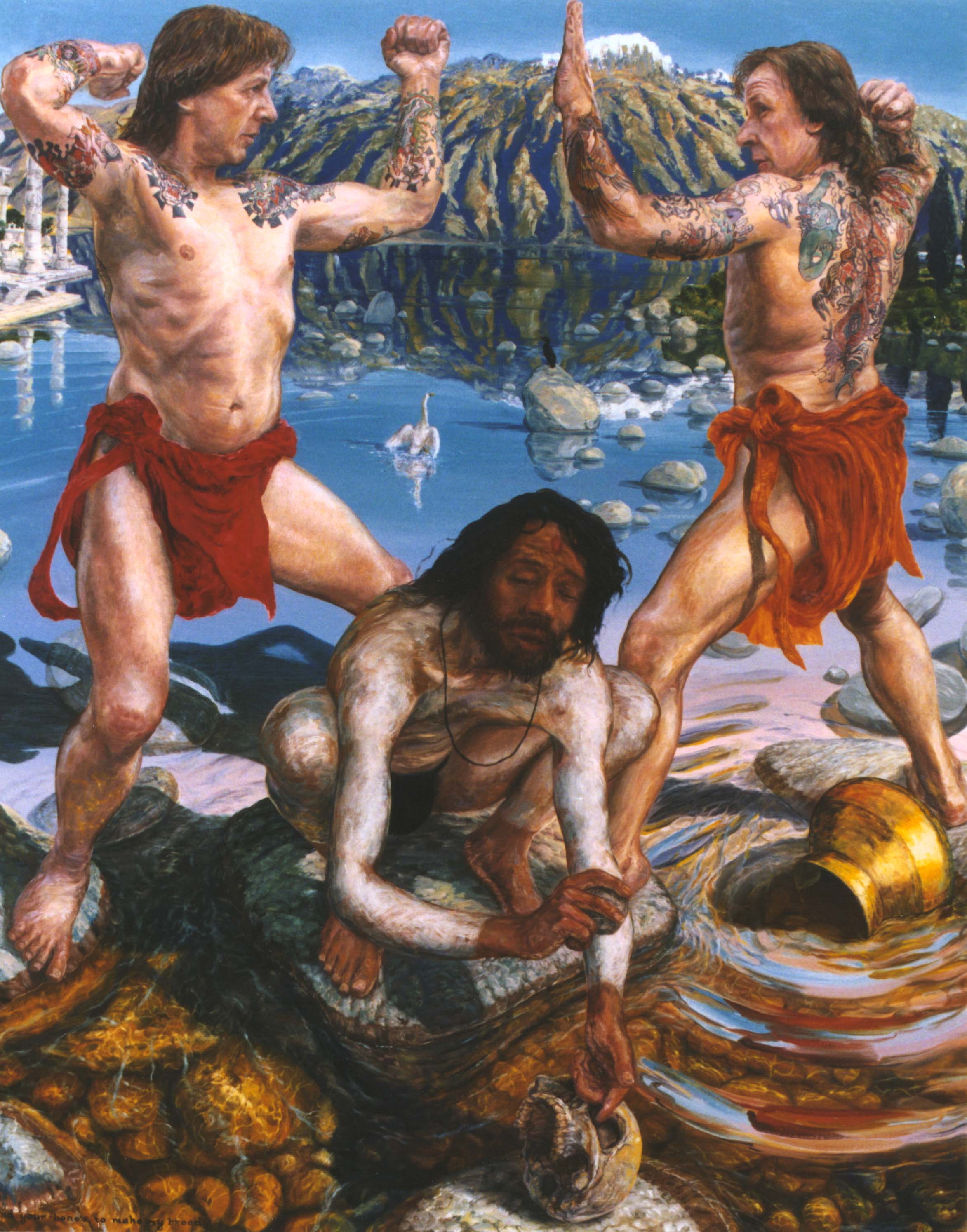
This is a picture about attack, defence, and the third way. The two combatants are mirror images of the same will to conquer. Their karate postures display the science, and their tattoos tell the narrative, of their conflict. Meanwhile, the central character, inspired by the “Agori” holy men of India; needs only a feeding bowl made from the cranium of one, dead.
The original inspiration for this work was an early silent film showing a comic fight between a blackened chimney sweep, (with a bag of soot) and a whitened miller (with a bag of flour). Both men, of course ended up grey and indistinguishable.
In India, the “Agori” wears only the grey ashes from funeral pyres.
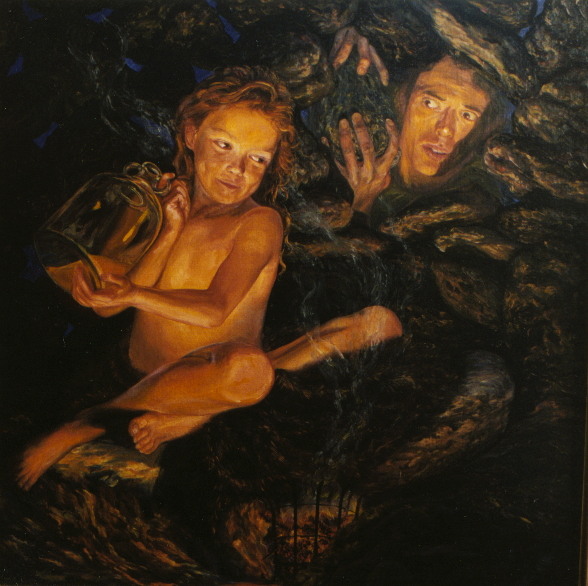
…When close to his right hand a heap of grey stones and a rocky ledge reminding him that he could make, if he shifted a few stones, a shelter till the daylight broke. But while he fumbled with the stones they toppled over, ‘were it not I have a lucky wooden shin I had been hurt’; and toppling brought before his eyes, where stones had been, a dark deep hole in the rock’s face. He gave a gasp and thought to run, being certain it was no right place but the Hellmouth at Cruachan that’s stuffed with all that’s old and bad, and yet stood still, because inside he had seen a red-haired jolly lad in some outlandish coat beside a ladle and a tub of beer, plainly no phantom by his look. So with a laugh at his own fear, he crawled into that pleasant nook.
William Butler Yeats, Responsibilities (1994)
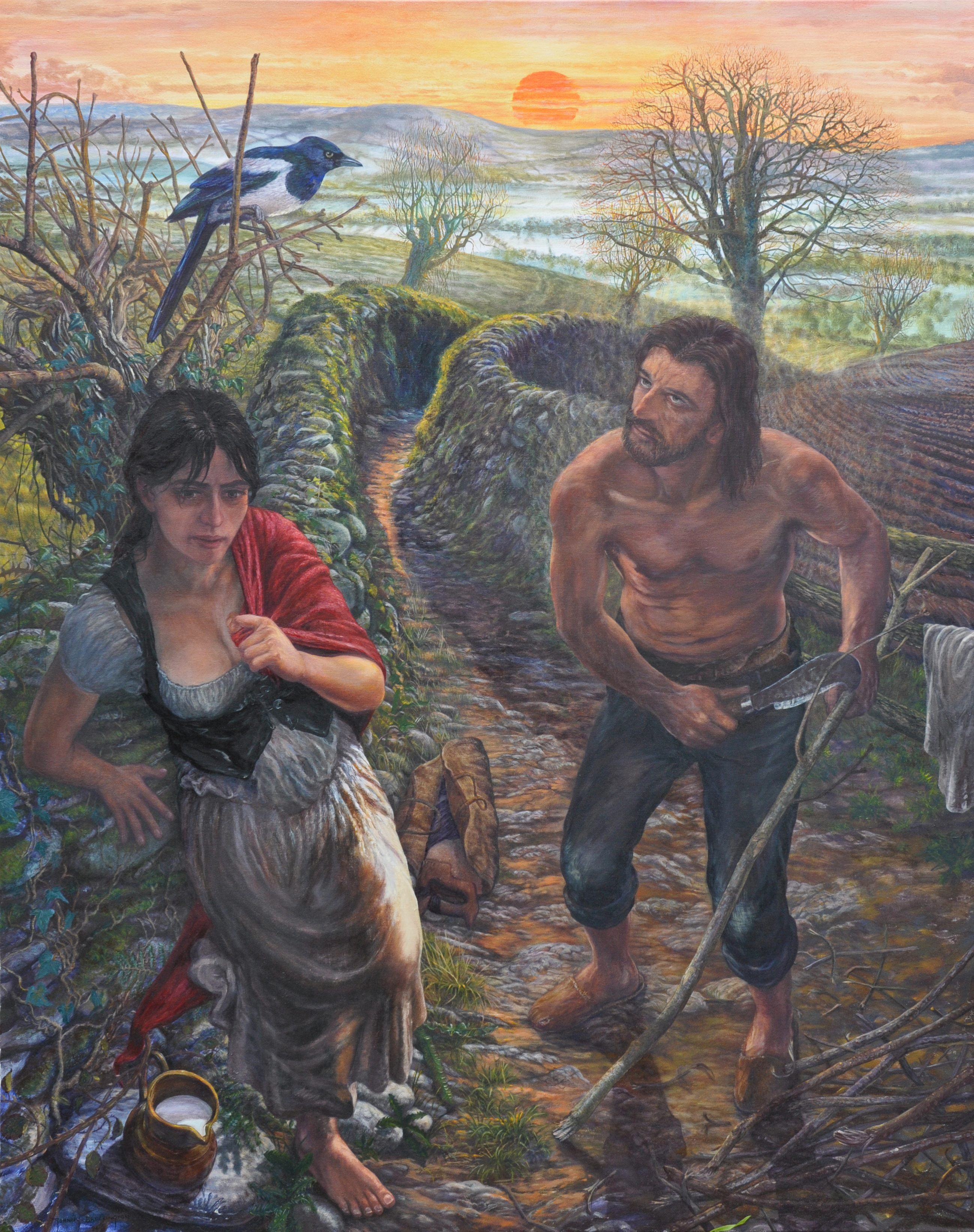
Within the fire and out upon the sea,
Crazy Man Michael was walking.
He met with a raven with eyes black as coals,
And shortly they were a-talking.
Your future, your future I would tell to you,
Your future you often have asked me.
Your true love will die by your own right hand,
And crazy man Michael will cursèd be.
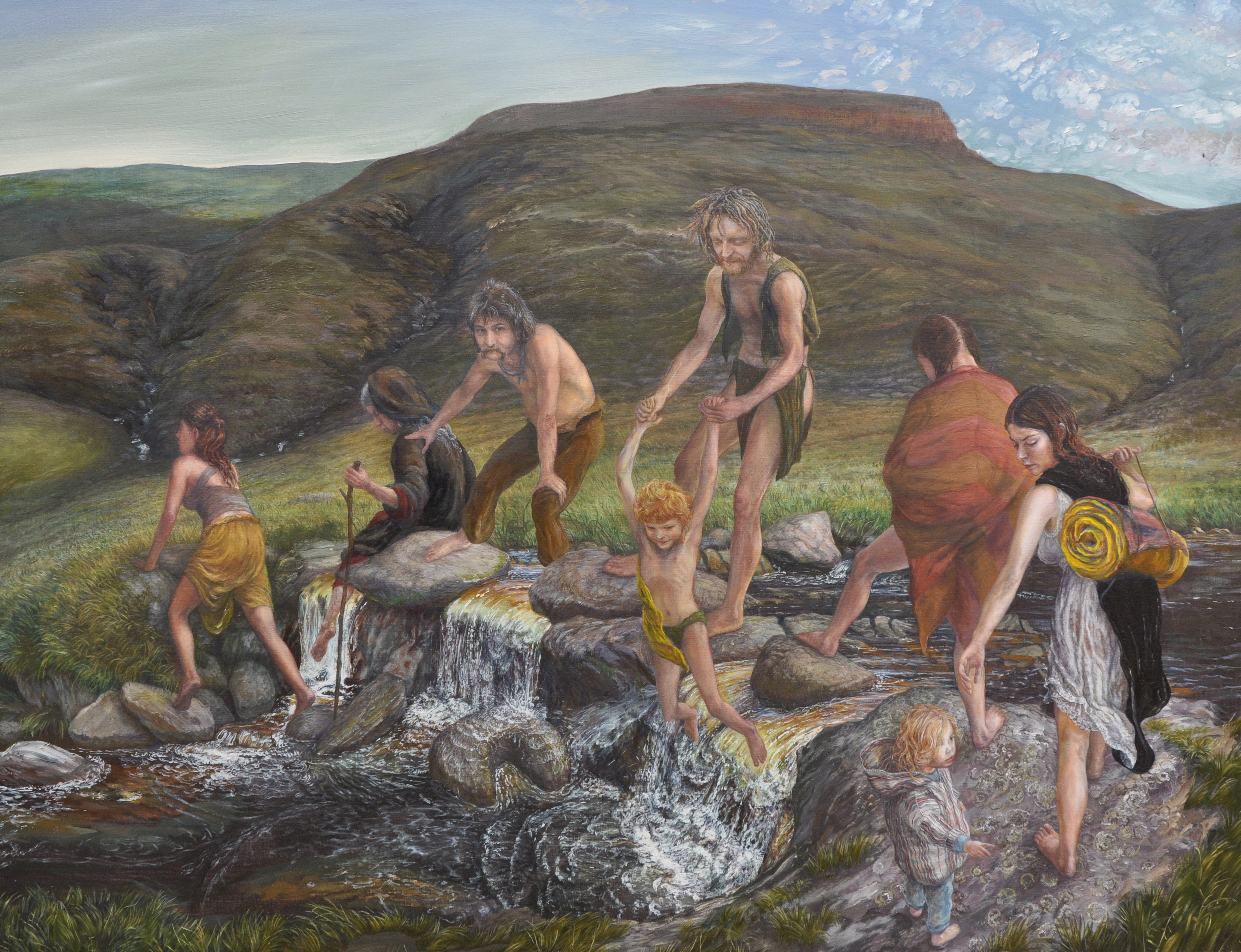
Once again the context is the ancient past and man’s place in the environment. This landscape is from the Welsh Brecon Beacons at Cerrig Duon. Here the landscape is scattered with ancient sacred sights like the stone circle just visible on the left. Dwarfed as these constructions are in the immense wilderness, they were nevertheless magnets to the far flung population at certain times in the calendar. The journey then, has a special intrinsic significance; and here it is shown both as a festive outing (centre panel) and as an astral travelling (right panel) akin to the Aboriginal ‘Walkabout.”
Man Journey is realised on triptych inner panels. Please note that when collapsed the work’s width is 49 inches.
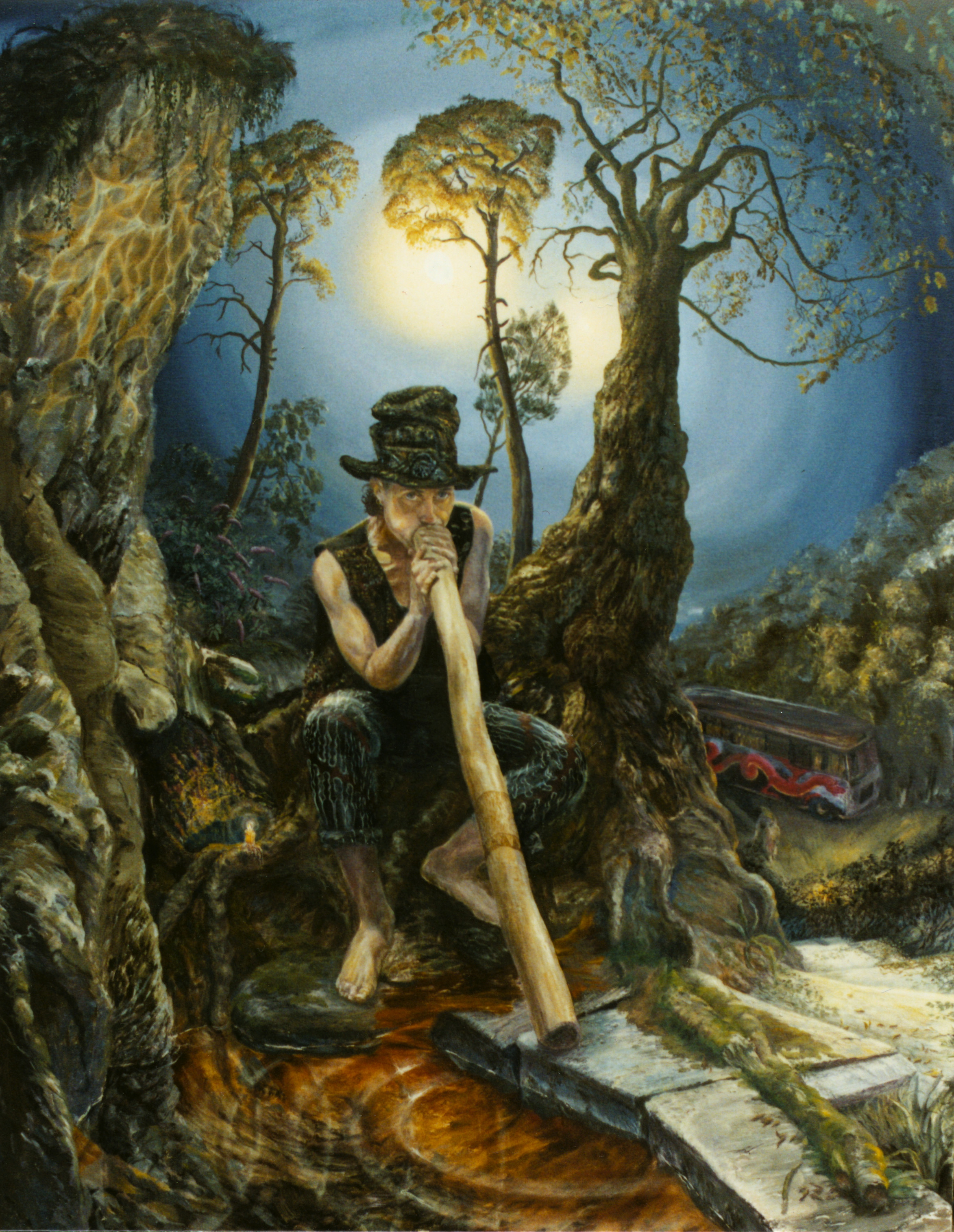
On the festival circuit during the 1990s, the didgeridoo was played and hawked by everyone and their dog. Mostly this was to the detriment of a ‘roots’ fascination with the pure Aboriginal creation, but there were exceptions. Steven Cragg was one of them, a serious devotee and virtuoso player, and I sat at his feet for a few good sessions at Reading’s Womad and Bristol’s Ashton Court festivals during that decade.
His solo playing was augmented by amplification and electronic delay effects creating a haunting accompaniment. For hours afterwards my thorax continued to resonate from the sub-sonics; it didn’t take long for a painting to materialise in my mind.
I wanted to express the totem power of the Didgeridoo; the elemental ability to key in to core earth resonances. Resonance was the key – and a standing wave on water would do beautifully – so the Druid sacred spring came into being.
The landscape appeared on a walk in the woods around Swiss valley Clevedon; the anthropomorphic rocks, the vertiginous drop and those long spindly pine trees just demanded to be painted.
The title ‘Two Moon Valley’ is from Jack London (one of my kindred spirits). I think it was the name of his ill-fated ranch.
The painting was done very quickly; first drawn directly with a freehand brush and only a scrappy sketch for layout.
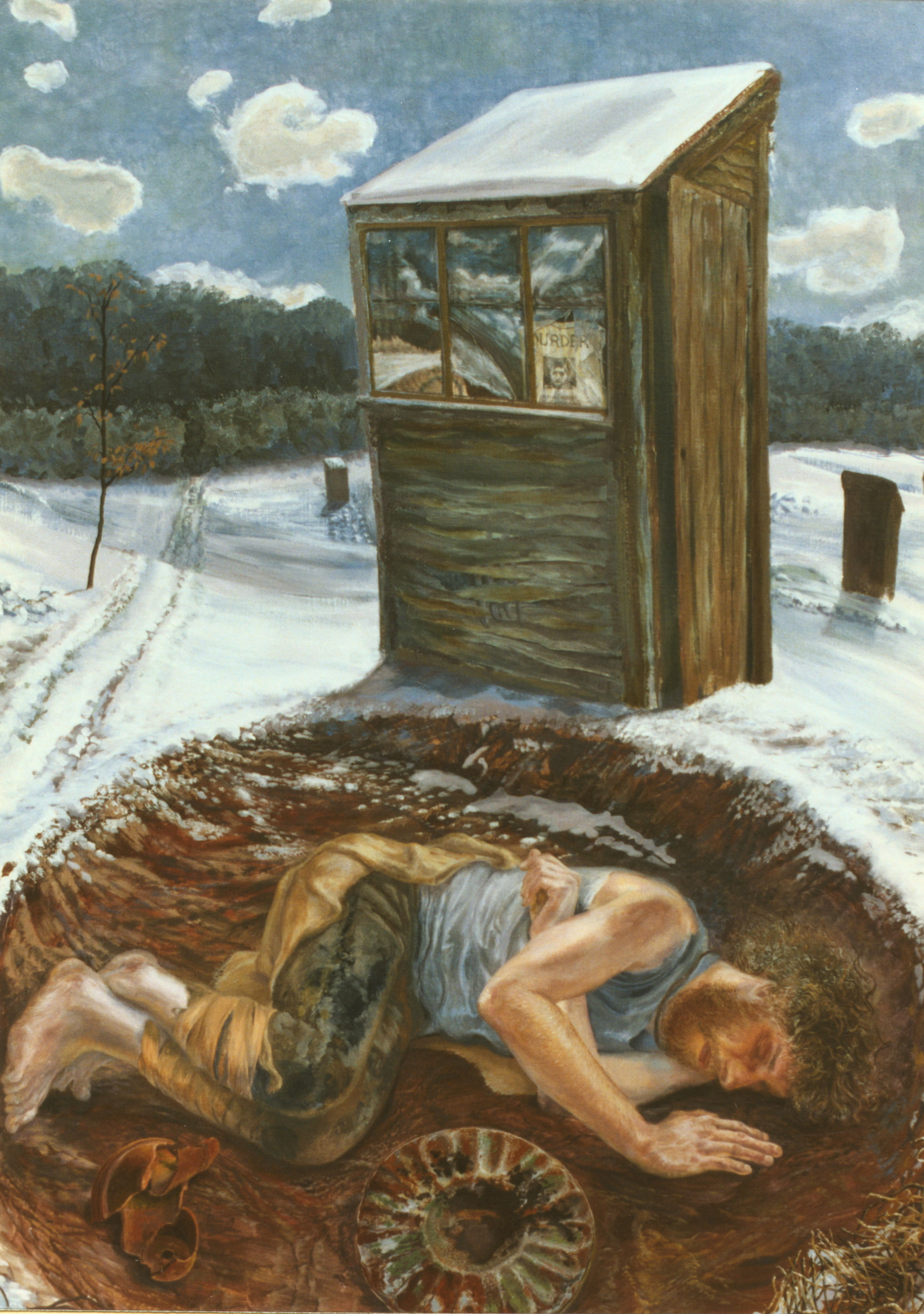
In northern Europe, in the dark ages, ritual human sacrifice was performed to ensure the return of the sun in the spring. The victim was garotted and thrown into a bog. Some of these unfortunates have been found, perfectly preserved by the peat in which they lay for a thousand years. Their world was replete with symbols of death and re-birth and this painting is drawn diagrammatically from scenes on the magnificent GUNDESTRUP cauldron (A.D. 400) a votive offering found in a Danish bog.
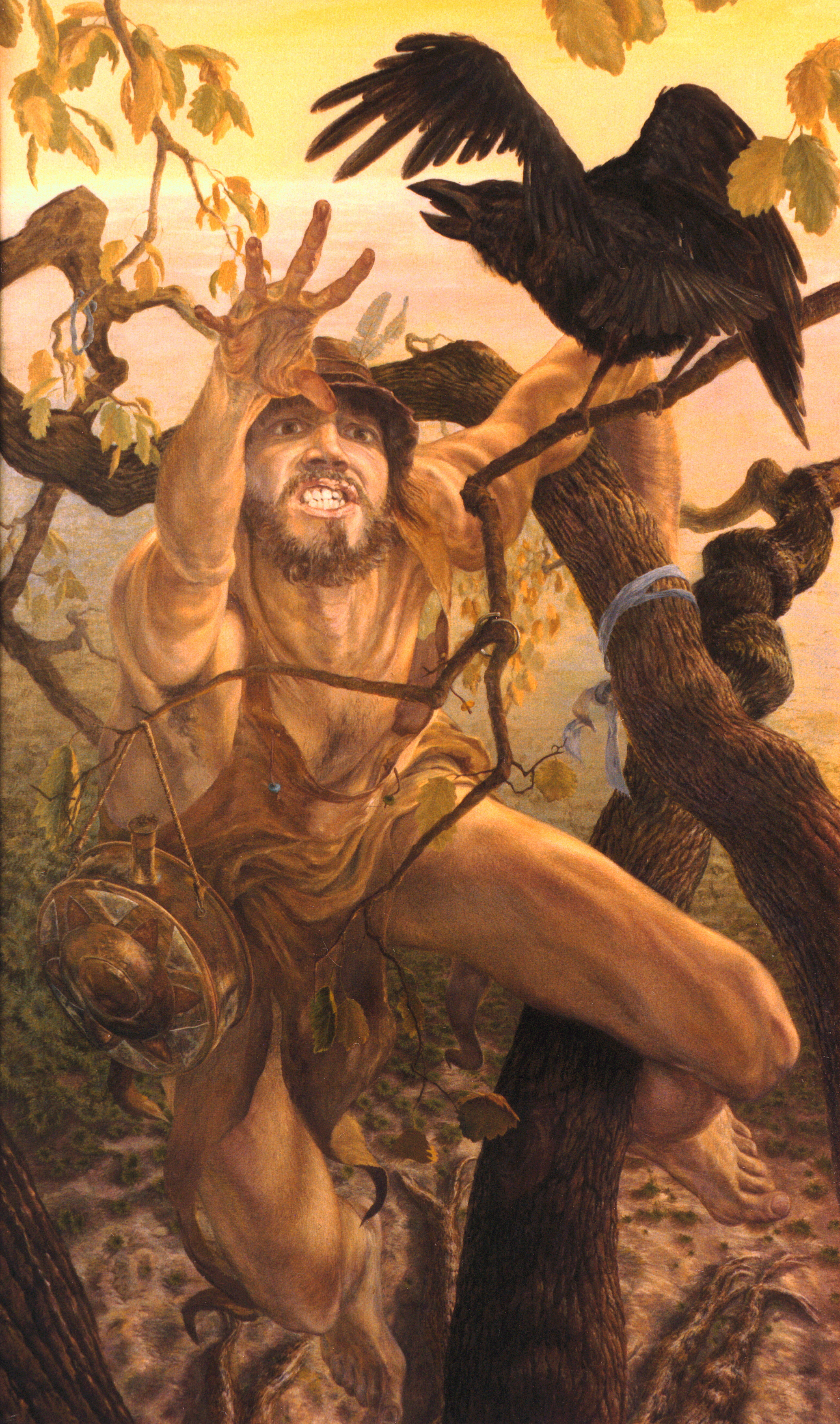
Every primitive culture has its “witch doctor” and The Shaman is one such character. Often using hallucinogenics, Shamans cavort into the realm of ecstatic trance to master the unseen forces of nature and penetrate into the spirit world. In Shamanic lore, the world-tree ascends into the sky-realm; climbing it for the Shaman is an enactment of spiritual flight – up here dwells the Raven, companion of flight and the oracle of the dead.
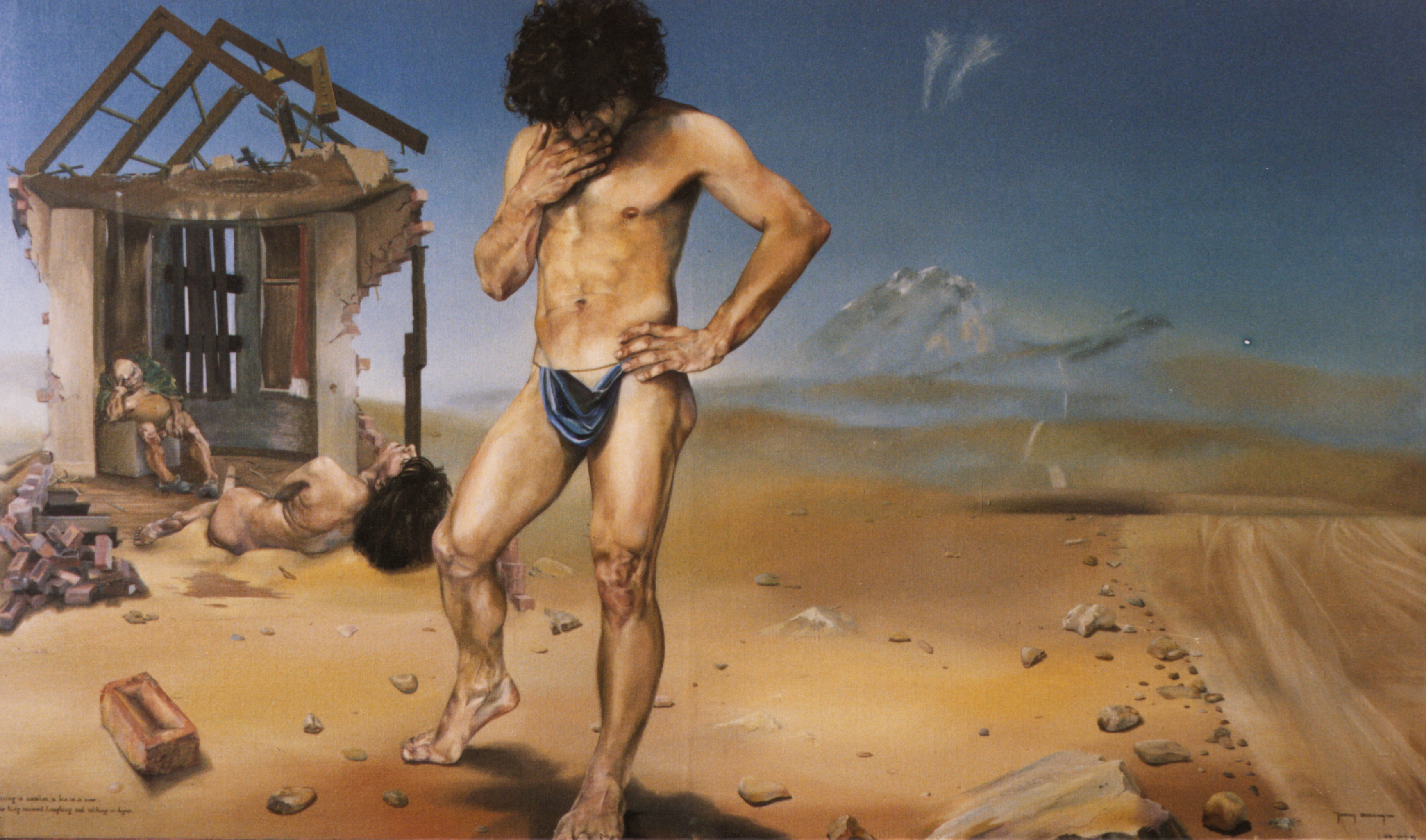
What is a King, what is a castle? As a narrative, this picture uses the well known triangle of John the Baptist (main figure), Salome and king Herod. As the story of corruption unfolds, the concepts and identities of power and justice distort.
Full title: Living in castles, A bit at a time
The King started laughing and talking in rhyme