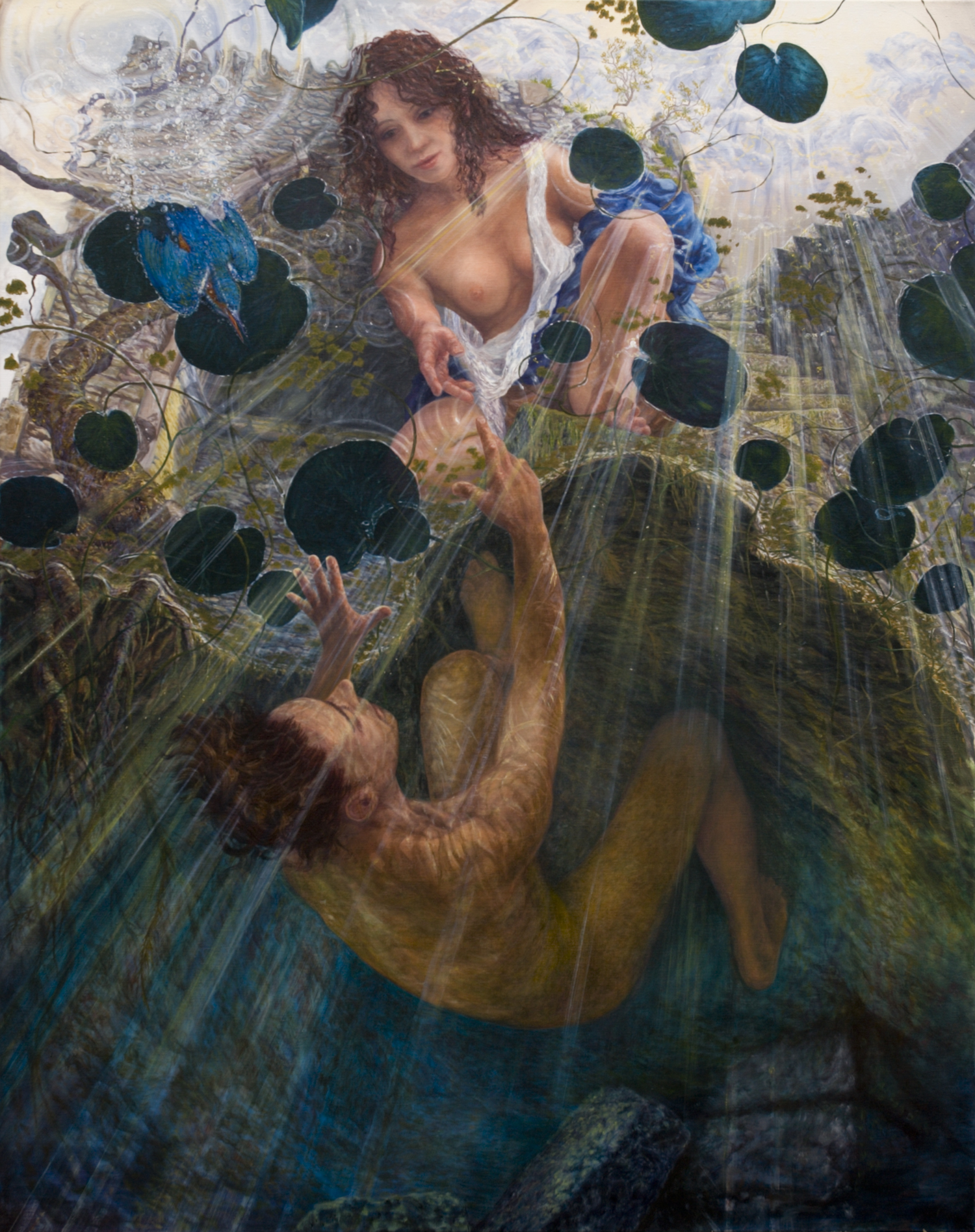
Orphee

Partly inspired by Jean Cocteau’s surrealist film of the same name (1928), this picture explores levels of reality. The two worlds are reflections seen in a plane of water by the characters; male and female aspects of one being. Does she beckon him up or he seek to drag her down?

Perhaps only the kingfisher, in its plunge, can pass between the worlds.

Just as was Cocteau’s film, it is likewise a treatment of ‘Orpheus in the underworld’ from Greek myth. That is to say, a visualisation of Orpheus approaching the barrier between our ‘real’ world and that ‘beyond’. In Ovid, that land is Hades, the land of the dead. In Cocteau it is ‘beyond the mirror’, where surreality holds sway. In this painting the barrier separates  the co-existent duality of opposites, ying and yang, animus and anima, here manifest in the duality of the sexes: male this side, female the other. The figures therefore represent opposite versions of the same being and one side of the divide is no more ‘real’ than the other.

It is a twist on the notion of staring at your reflection in the water and reaching out a hand towards it…as your hand and that of the reflection’s come together, the water is disturbed and the reflection disperses…..in this case however, the point of touch will be with a real (meta)physical presence: both are real but virtual to each other…can the barrier be crossed? That is the essence of the picture. The kingfisher does cross, effortlessly, but this could be a form of magic or the stuff of dreams, as in the Cocteau film.

The architecture is based on an abandoned monastery in Galicia, Spain; one of the most unsettling places I have ever been.
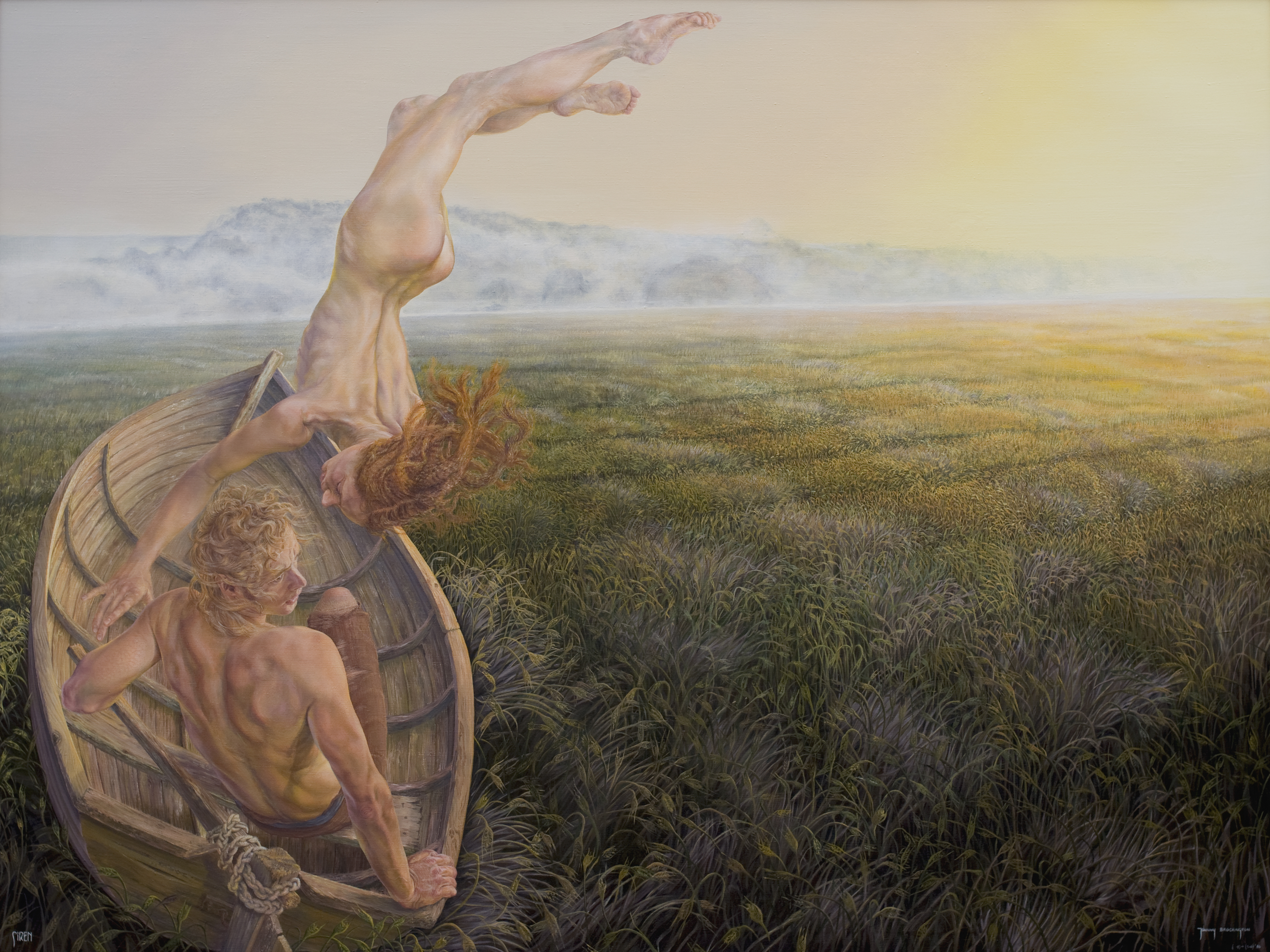
Siren

The Siren is the mythological ‘femme fatale’ who lures unwary sailors onto the rocks. In this painting, a field of barley symbolizes the fecund ocean of life’s journey. As in Homer’s Odyssey, the sailor must resist this alluring distraction in order to pursue his true path, but the encounter, as Jung informs us, is also an internal one between the Man and his inner Woman ; either way – he turns aside…

I have always enjoyed a tendency for willful juxtaposition of elements in my paintings, giving the effect of a kind of forced symbolism. In literature it would be called metaphor and can be deconstructed intellectually, but in painting it can excite the imagination in unexpected and unfathomable ways. The impulse to marry the boat and the field of barley comes from the beautiful effect we will all have seen, where the wind transforms these grasses to seem like the surface of a lake or sea. This actual field loomed out of the mist at me, one early dawn on a drive across Salisbury plain… I stood at the lonely roadside and marveled at it – never to be forgotten.

The figure of the Siren was inspired by the incredible grace (and flexibility) of Edwina, my favorite model of those years, moonlighting from her role as dancer at the Ballet Rambert.
Stylistically, this painting was the culmination of my pre-raphaelite tendencies, albeit with a strong dose of symbolism. I disciplined myself, like them, to copy faithfully from nature, actual objects and live models.

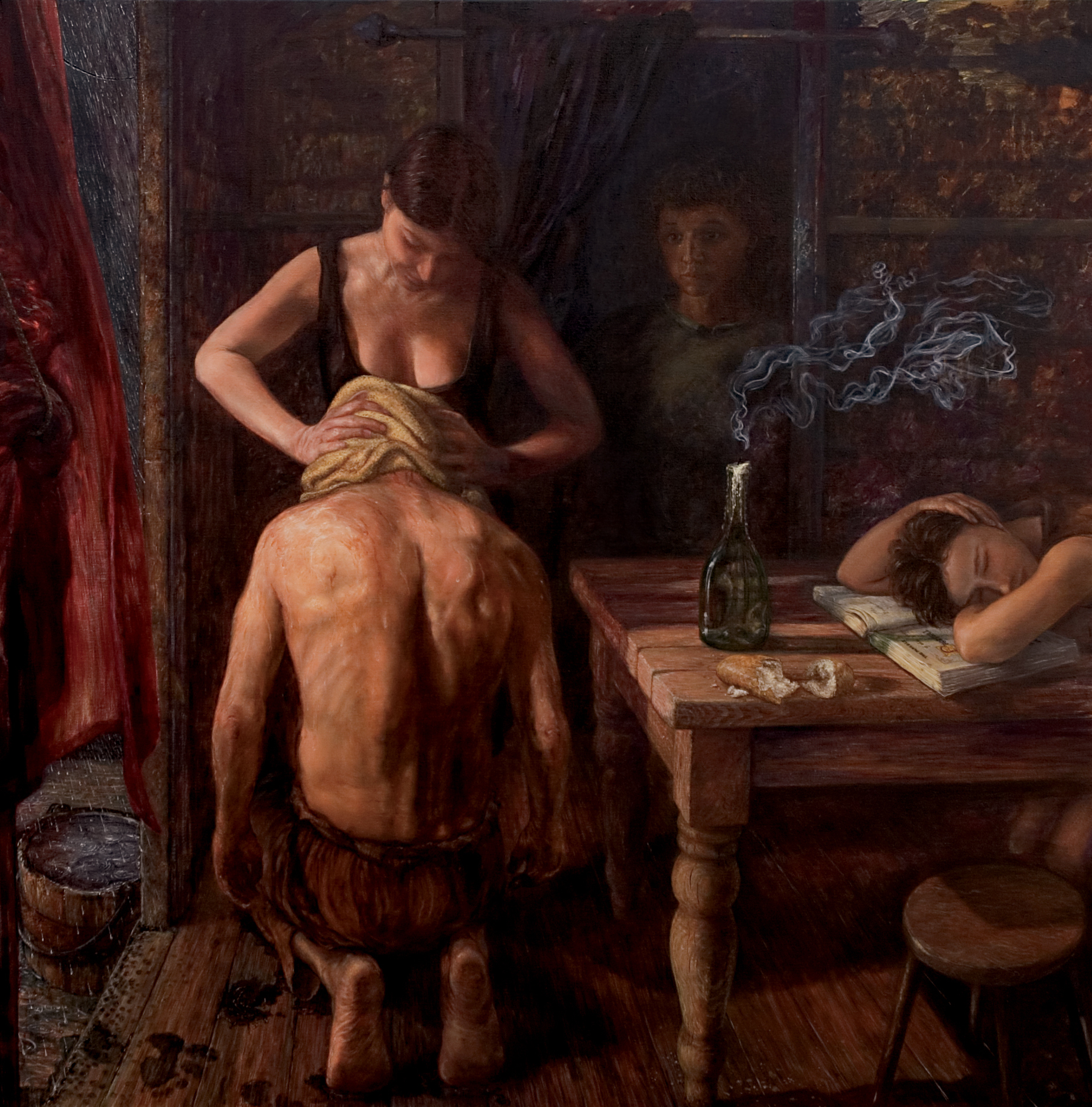
The Prodigal

The father’s return is rife with tension. The picture reworks Rembrandt’s treatment of the same subject.

Contact

Oil On Canvas Fine Art

Realism, Narrative and Symbolism.

I think painting can be as effective as literature in communicating these elements but without them, it is in danger of becoming solely decorative.

I have explored these same stylistic channels my whole career and tried to underpin them with strong figure drawing and traditional techniques: The result is a body of work with a wide ranging content, but always with a recognizable character. The images are hopefully enticing enough so that the viewer will look for meaning and ultimately be rewarded.

Nobody works happily in a vacuum but fortunately Painting is a solitary and contemplative pursuit that ,of itself, does bring great fulfillment and gives the artist that rare feeling of having achieved. Whilst it has not made me rich, it has made me, at times – happy.

Explore the full collection in my gallery